How to Play Poker
Table of Contents
- A History of Poker
- Poker Strategy
- The Power of Position
- Fundamentals of Preflop Play
- Drawing Hands
- Suited Connectors
- Playing Big Pairs
- Three Betting
- Poker Math & Expected Value (+EV)
- Post Flop Play
- Advanced Post-Flop Concepts
- Bet Sizing
- Bankroll Management
- The Mental Game of Poker
- The Benefits of Table Starting
Poker they say is a game that takes a minute to learn and a life time to master. The aim of this work is to provide a broad overview of poker strategy so that if someone takes the time to read and digest the information within, as well as following the recommended exercises, they will be able to play poker at a fairly high level. While the term poker encompasses a broad range of games, the essence is that you are making five card combinations, ranked from high card at the bottom to straight flush at the top. Hands are ranked in order of difficulty to make. The more difficult it is to make a hand, the higher it is ranked. The easiest hand to make is high card, so it has the lowest value. From there the ranks are one pair, two pair, three of a kind, straight, flush, full house, four of a kind, straight flush.
Poker can be played with between 2 and 10 players, and for any amount of money. But you do have to play for money. This guide is going to be focused on No Limit Texas Hold'em, which is the most popular form of poker at the moment. Each poker variant has its own intricacies so while a lot of the core strategic concepts will apply from variant to variant, it is a mistake to imagine that one form of poker is more or less like another. Even simply changing the betting structure from Limit to No Limit can lead to profound differences in both strategy and tactic.
A History of Poker
Poker is more than a game of cards; it is a rich tapestry of cultural evolution, risk, mathematics, and human psychology. Over two centuries, poker evolved from clandestine card games on 19th-century steamships into a multi-billion-dollar global sport and complex game-theoretic science.
Ancient Ancestors & European Origins
While poker’s direct lineage is often debated, card historians trace its mechanics to ancient Persian card games like As-Nas, played with 25 cards across five suits. In 16th-century Europe, the Spanish game Primero introduced concepts of betting and bluffing, earning it the title of "poker's mother."
By the 17th and 18th centuries, the game had migrated to France as Poque and Germany as Pochen ("to knock"). French settlers brought Poque to North America when they founded New Orleans in 1718, laying the groundwork for the modern game.
The English word "Poker" is a direct phonetic adaptation of the French word Poque, which itself derived from the German Pochen, meaning to brag or knock on the table.
Mississippi Riverboats & The Frontier Era
In the early 19th century, poker became the favored pastime on Mississippi steamships and in New Orleans gambling dens. Originally played with just a 20-card deck (Aces through Tens distributed to four players), players bet on who held the strongest combination.
As the game expanded Westward during the American Gold Rush, the standard 52-card deck was introduced to allow more players at the table. This era introduced the Flush and the Straight into hand rankings, as well as the Draw Poker variant. By the American Civil War, Stud poker had emerged, becoming the primary version played by soldiers on both sides.

In 1876, legendary lawman James Butler "Wild Bill" Hickok was shot in the back of the head during a poker game in Deadwood, Dakota Territory. He died holding two pair: black Aces and black Eights (A♠ A♣ 8♠ 8♣)—forever known as the Dead Man's Hand.
Texas Hold'em & The Birth of Vegas Poker
While Five Card Draw and Seven Card Stud dominated early casinos, a new variant emerged in Robstown, Texas in the early 1900s: Texas Hold'em. Hold'em allowed for four streets of betting with community cards, opening up vastly deeper strategic depth, positional play, and high-stakes bluffing.
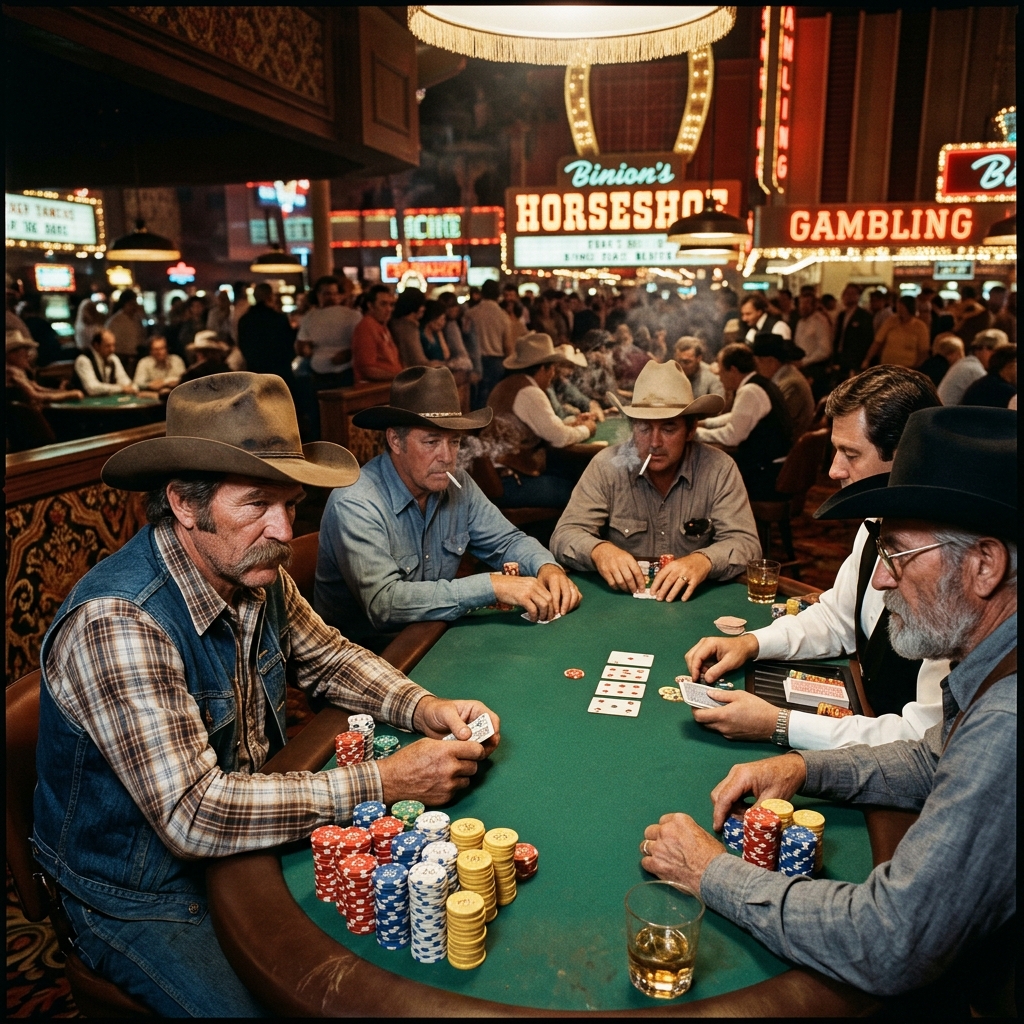
In 1967, Texas road gamblers including Doyle Brunson, Crandell Addington, and Amarillo Slim brought Texas Hold'em to Las Vegas at the California Club. In 1970, casino legend Benny Binion launched the first World Series of Poker (WSOP) at Binion's Horseshoe. The $10,000 No-Limit Hold'em Main Event quickly became poker's ultimate championship.
The Limit Hold'em Era: When No-Limit Was "Dead"
From the 1980s through the late 1990s, Limit Texas Hold'em was the undisputed ruler of casino cardrooms. Staples like $3-$6, $4-$8, and $10-$20 Limit games filled floors in Las Vegas and Los Angeles, while No-Limit Hold'em cash games had virtually vanished outside of major tournament side action.
Writing in 1991, 2+2 strategy pioneer Mason Malmuth observed that No-Limit cash games had effectively died out because they were unforgiving: inexperienced players got stacked far too quickly, whereas Limit Hold'em allowed casual players to socialize, survive mistakes, and play for hours without losing their entire bankroll in a single hand. As poker historian Nolan Dalla reflected, Limit Hold'em was about "shearing the sheep" over time, creating a stable, long-lasting poker ecosystem before No-Limit made its explosive comeback.
"What has happened to no-limit games? I don’t know of any regularly spread in Las Vegas or LA cardrooms... these games have died out. No-limit was too easy to play well, and if you didn’t play well, you were quickly cleaned out." — In 1991, poker experts believed No-Limit was doomed because weak players broke too fast. Limit Hold'em was considered far better for the health and longevity of cardrooms.
The Poker Boom & The Proliferation of No-Limit Hold'em
The late 1990s and early 2000s sparked the single largest revolution in gaming history: the convergence of online poker platforms, hole-card camera television broadcasts, and the explosive rise of No-Limit Hold'em (NLHE) as the universal standard of poker.
1. The Birth of Online Cardrooms & Mass Accessibility
In January 1998, Planet Poker dealt the first real-money online hand, followed quickly by platforms like Paradise Poker, PartyPoker, and PokerStars. For the first time, anyone with an internet connection could play 24/7. Online poker removed physical geographic barriers, lowered entry costs with micro-stakes ($0.01/$0.02), and allowed players to "multi-table"—playing 4, 8, or even 16 games simultaneously. This allowed a new generation of players to gain decades of hand experience in a matter of months.
2. Televised Drama & The Moneymaker Effect (2003)
In 1997, Henry Orenstein patented the hole-card camera, allowing TV audiences to see players' hidden cards. Shows like the World Poker Tour (WPT) and ESPN's WSOP coverage turned poker into high-octane prime-time drama. The defining turning point arrived in 2003, when 27-year-old accountant Chris Moneymaker turned an $86 online satellite entry on PokerStars into the $2.5 million WSOP Main Event title.
The "Moneymaker Effect" proved that an amateur could conquer world champions live on television. Online satellite tournaments exploded, sending thousands of online qualifiers to live events around the globe (WSOP, WPT, EPT), inflating tournament prize pools to tens of millions of dollars.
3. Why No-Limit Hold'em Conquered Live & Online Gaming
Dubbed by Doyle Brunson as "The Cadillac of Poker," No-Limit Hold'em possessed the perfect balance of simple rules and infinite strategic depth. Unlike Limit Hold'em, where bet sizes were fixed, No-Limit allowed players to leverage their entire chip stack at any time. This created massive fold equity, dramatic bluffs, and devastating traps that captivated television viewers and cash-game players alike.
Driven by TV hype and online action, brick-and-mortar cardrooms in Las Vegas, Los Angeles, and Europe underwent a permanent shift. Players demanded $1/$2 and $2/$5 No-Limit cash games. Within a few short years, Limit Hold'em was displaced from main casino floors, and No-Limit Hold'em established itself as the undisputed, dominant form of poker worldwide.
4. The Online Internet Phenoms & High-Stakes Era
Online strategy forums (like 2+2), tracking software (PokerTracker), and early video training sites created a wave of young internet prodigies. Online phenoms like Tom "durrrr" Dwan, Phil Galfond, and Viktor "Isildur1" Blom stepped out from internet cash games into iconic televised cash shows like High Stakes Poker and Poker After Dark, battling old-school legends in legendary multi-million-dollar pots.
Limit Hold'em was difficult to televise because bets were incremental and incremental folding was passive. No-Limit Hold'em, with its heart-stopping "All-In" moments and stack-at-risk bets, created unparalleled cinematic suspense for television audiences.
The Solver Era, AI & Global Streaming
Today, poker has entered the era of quantitative science and game theory. The advent of GTO (Game Theory Optimal) Solvers like PioSOLVER and GTO Wizard revolutionized high-stakes strategy, replacing pure intuition with mathematically sound equilibrium play.
AI landmarks—such as Carnegie Mellon's Libratus and Pluribus defeating elite human pros in six-player No-Limit Hold'em—proved that complex imperfect-information games could be solved. Concurrently, live streaming platforms (Twitch, YouTube, Hustler Casino Live) have brought unedited high-stakes cash games to millions of live viewers across the globe.

Poker Strategy
The essence of winning poker strategy is to play tight but aggressive. Tight means you fold a lot, especially before the flop. As Tommy Angelo once wrote "folding builds latent winning potential". Tight players do well over time because strong hands preflop translate to strong holdings postflop. If you have your opponent dominated, say with AQ vs QT, and the flop comes with a queen, you stand to make a lot of money. And even if QT does happen to outflop AQ, say with a T72 flop, AQ has nothing and will probably get away more or less unscathed. Big cards win money in NLHE because they end up making better hands. Top pair instead of bottom pair. Nut flush instead of a low flush. And it really is that simple. In fact, you can pretty much just sit around and wait for really strong hands in a lot of games, and do very well. Luckily, there is much more to poker strategy than simply sitting around and waiting for the goods. As complicated and nuanced as preflop strategy can be, post flop strategy is infinitely more complex.
The Power of Position
In No-Limit Hold'em, your position at the table relative to the dealer button is arguably the single most important factor in any given hand—even more important than the cards you are holding. Position dictates who acts first and who acts last on every post-flop street. The player who acts last has a massive, mathematically proven advantage.
There are three main categories of position:
- Early Position (EP): The first few seats to act after the blinds. Players in early position have to act before the rest of the table, meaning they have the least amount of information. Because of this disadvantage, you must play a very tight range of strong hands from EP.
- Middle Position (MP): The seats in the middle of the table. You have position on early position players, but are still vulnerable to players acting behind you. Your starting hand requirements can loosen up slightly compared to EP.
- Late Position (LP): The Cutoff (CO) and the Button (BU). The Button is the best seat at the table because it guarantees you will act last on the flop, turn, and river. You can play a much wider range of hands from late position.
Why Acting Last is a Superpower
1. The Informational Advantage: Poker is a game of incomplete information. When you act last, you get to see exactly what your opponents do before you have to make a decision. If they check, you know they likely have a weak hand or are trying to trap. If they bet large, you know they are claiming strength. This information allows you to make far more accurate decisions than the players who had to act blindly before you.
2. Pot Control: When you are in position, you have the ultimate say over the size of the pot. If you have a marginal hand or a draw and your opponent checks to you, you can simply check back to see a free card and keep the pot small. If you have a monster hand, you can bet to build the pot. Out of position, you cannot control the pot size as effectively because your opponent always has the final say on whether money goes in.
3. Bluffing Equity: It is significantly easier to bluff when you are in position. If the action checks to you, it is an indicator of weakness, and a well-timed bet can often win the pot uncontested. Out of position, bluffing is much riskier because you are firing into the dark, unaware of whether your opponent holds a trap or a monster hand.
Because of these three factors, you will naturally win more money (and lose less) when playing in position. This is why preflop opening charts advocate opening very few hands from Under the Gun (UTG) and opening a vast array of hands from the Button.
Fundamentals of Preflop Play
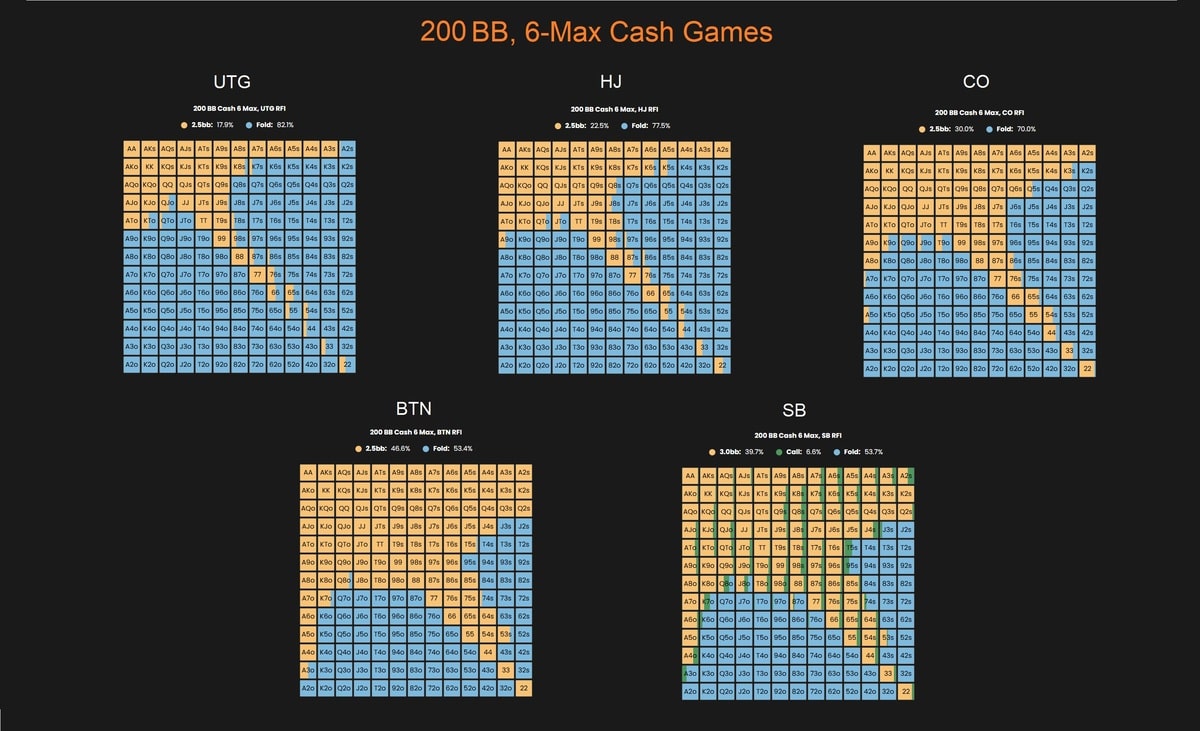
The first and most important concept to learn about preflop play is what to raise when you are first in (RFI). The above charts are fairly simple. Blue you fold and beige you raise. RFI standards are more or less static so they are relatively easy to learn, although you can also adjust your range on the basis of game conditions. Note that UTG - and this is for a 6 max game - we open 17.9% of the time. This number increases to 22.5%, then 30%, then 46.6% for HJ, CO, and BU respectively. It reaches its peak at BU and the author advocates a mixed strategy for SB vs BB. These charts were found at PokerAti.com and have been reproduced here without permission.
Preflop charts can be valuable tools. But what if we are not first in? That is what if there is action in front of us. Then the chart no longer applies. Instead we must either three bet, call, or fold. And this is a good time to introduce 'the gap concept', which is that it takes a much stronger hand to play against a raise than to raise yourself. So right away, if someone raises, you are going to fold mostly. A good default strategy is to three bet AK, QQ, KK, AA, and to flat TT, JJ, AQs and to fold everything else. But it really depends on how they play. And this introduces a second important concept. In poker, everything is relative.
Adapting to Limpers
Another common situation is when someone has limped in before us. Generally, I will want a stronger hand to isolate a limper (to isolate or iso just means we raise after someone has limped) than I will do simply open from the same position. First, we are risking more money. While I might open for 3x, I am going to generally prefer to isolate a single limper for 4x. If there are multiple limpers, I will raise even more. And remember, we are risking that money not just against the limper, but against everyone at the table. And there is also the danger that someone can flat or reraise a superior hand against us. We also have the option to over limp, which I will do with certain speculative holdings, like small pairs. However, you still have to account for the possibiltiy of a big raise from behind you, so you don't want to speculate too much unless table conditions warrant it. Basically for a speculative limp to be worth it, there has to be a high % chance you are getting to the flop for a single bet. Otherwise you should just fold.
Concept #1 : The Gap Concept
The gap concept, as we just said, means it takes a much stronger hand to play against a raise, than to raise yourself. Let's explore this a little more. Let's say you are in the cut off or CO and everyone folds to you. This means that only the button, the small blind, and the big blind remain to act. Let's say you have 99, and you want to know how likely it is that you have the best hand. Well, there are only 5 hands that beat you, TT, JJ, QQ, KK, or AA. That is 5 x 6 = 30 combos of hands that beat you. There is only a 2.26% chance that any one particular opponent has a better hand than 99. There is a 3.47% chance one player has a TT-AA, and AK. I have chosen to include AK, even though 99 is a favourite, because if someone three bets you when they have a range of TT-AA and AK, you should probably just fold. So the fact that they will play AK like it is the best hand means it is the best hand. Or should be treated as if it is. Anyway, because there is a 96.53% chance that any one player does not beat 99, you can take that to third power and get 89.95%. That means there is a 90% chance that 99 is the best hand. Now people could have ATs, or KQs, and be competitive against you. But we know most of the time we will have the best hand before the flop, because it is just us, with a pretty strong hand against three random hands. They could have anything. Now let's look at our hand vs a raise. Even if we give our opponent a healthy 10% range, we aren't beating much. We beat 77 and 88, and A9ss. That is only 13 combos. We lose to or flip vs the rest. So we have to hope that we are against the soft part of his range, over cards or 77 or 88, and that we get a safe flop, and that we hold. That's a bit of a parlay. Now I'm not saying you can or cannot call a raise with 99. Just that we are in a much better situation it is folded to us in late position, than if we are facing an EP raise. The gap concept. You need a better hand to play vs a raise than you do to raise yourself. And this is applicable to many poker situations.Concept #2 : All Hands Are Relative
A very tight raiser opens in early position for 5BB. We are in the CO with AKo and there are two loose players in the blinds. What do we do? A lot of players would just three bet here without thinking
because they have ace king and ace king is a three bet. Poker players love simplistic rules like that. However in this case it is a mistake.
Let's look at the tight players range. It is JJ, QQ, KK, AA, and AK. 2.5% of hands (2.12% if we factor in your AK). Some players really are that tight. And notice, we are not doing great against any of then.
In fact, against such a tight range, we are a 2:1 underdog.
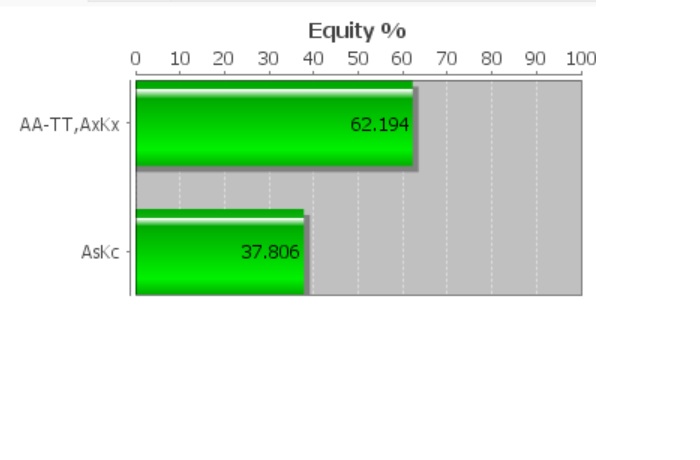
However, if we are to flat and allow one of the loose players into the pot, the situation changes dramatically. Now we are 31.77% in a three way pot vs 37% heads up. This corresponds
to a -4.69% edge on the action three way vs a -26% edge on the action heads up. Okay, maybe we should just fold in either situation, but we DEFINITELY should not
three bet. And if we make the preflop raisers range a little looser - giving them a 6% range for example, still very tight (AA-88, AJ+ only) - now we are 37% in a three way pot. So we have a a reasonable edge
but heads up we are an ever so slight dog with 49.329%. Furthermore, our loose opponent in the blind is probably going to make more postflop mistakes than the tight raiser, since marginal hands
are more difficult to play.
On the other hand, if villain is a very loose opener, opening a liberal 30% range including lots of broadway hands, some ace rag off suit, stronger suited connectors, then three betting AK is going to print.
Not only do you stand a good chance to take down the pot immediately, but post flop weak ranges translate into weak holdings. And villain will not be able to four bet you very often with such a weak range either.
Drawing Hands
We can taxonomize pocket pairs, suited connectors, and suited aces into the grouping of 'drawing hands' although it would be a serious mistake to treat these holdings as identical. The most important category is pocket pairs. Smaller pocket pairs derive most of their value from their ability to hit a set. They do have some showdown value, and anything that beats ace high should not be ignored, but especially in the context of loose live games where most pots are contested multiway, the showdown value of an unimproved pocket pair is negligible. You will flop a set 1 in 8.5 times (7.5:1 against). Determining whether or not to call with a pocket pair in order to 'set mine' is a complicated process, which most players do not appreciate. You will almost never be getting the direct pot odds to draw for your set. However, because you still have many streets of betting to go, improving to a set can be quite lucrative. The calculation is essentially this: first you calculate your pot odds. Let's say you are getting 3:1. Then you need to be able to win on average an additional 4.5 times the preflop call when you do hit your set. This is usually not difficult. Let's look at an example.You have 88 in the CO. UTG folds, UTG+1 raises to 3x the big blind, and MP flats. Everyone has 100 big blinds. Should we call or not?
First we should consider our pot odds. We are getting here only 2.5:1 in direct pot odds. Assuming this is a $1/$2 game, it would cost us $6 to call. There is $15 in the pot ($6 raise, $6 call, and the $3 in blinds) so 2.5:1. However, we are not closing the action. The BU, SB, or BB could all still raise. Therefore, our effective odds are actually worse, since vs a large reraise would probably want to fold our hand. However, if we do call, there is a good chance we go 4 way single raised to the flop, with one of the blinds or the button joining us. If that does happen, we are in a very good situation. If we flop a set, the pot will be around $24. And there will still be $194 to bet. Furthermore, with four players in the pot, it is likely that at least one player will flop a decent hand and give us some action after the flop. Discounting our pot odds to only 2:1, because of the possibility of a three bet, we only need to earn an additional 5.5 x $6 = $33 the times we hit a set. With a pot of $24, that shouldn't be too hard, as we still have three streets on which to get action.
How about suited connectors? Some have suggested that suited connectors can be played in a similar manner to pocket pairs, except they need better odds. That is a reasonable starting point. The idea behind a suited connector is that you are trying to make a straight or a flush, and get paid off big time. Like a pocket pair, a suited connector is a drawing or implied odds hand. Usually it makes nothing, or just a weak hand, but sometimes it makes a very strong hand or the nuts and as such can win a massive pot. Alternatively, others have argued that suited connectors can make a good light three bet. In fact both contentions might be true.
Another factor about suited connectors is that without them, and this is more of a metagame perspective, it is difficult for you to have many draws. This means you won't have many semi bluffing opportunities. And you won't have many bluffing opportunities either if you are only starting with premium hands. This isn't really a problem at low live stakes games, but in a tougher game it could be an issue. In general in low live stakes games you will not get many bluffing opportunities anyway, because pots are contested multiway and your opponents generally call too much. Suited connectors also broaden your postflop range. What I mean is, without them, you can't have draws, and you can't really make straights or flushes. This makes you a lot easier to play against. However, with suited connnectors in your range, you can both make these hands and you can represent them. This makes you a lot more difficult to play against, and allows you to employ a more dynamic strategy. This is most important in deep stack play, where leveraging the threat of large turn and river bets allows you to capitalize on substantial fold equity as well as to make punishing value bets.
In Theory of Poker, David Skalansky describes semi bluffing:
The semi-bluff is one ofthe least understood tools of poker, yet it is a very valuable and potent weapon. All professional players use it, and it may be used in any game. It may be a bet, a raise, or even a check-raise. Essentially you are representing a bigger hand than you actually have; however, in contrast to a pure bluff, your hand must have some chances of improving to the best hand.
There are many different types of semibluffs. Extremely strong draws, for example KhQh on JhTh2s, usually want your opponents to call. On the other hand, a hand like 5h6h on 7h3s2s is probably cheering for a fold, as a gutshot is a low probabiltiy draw. Having the semi bluff in your arsenal is important, because if your bets usually represent either strong hands or draws, then your opponents will be faced with some tough decisions. They don't want to fold to your draws, but they also want to avoid paying off your strong made hands. Simply by mixing in some semi bluffs, your strategy has become considerably more sophisticated and difficult to combat.
Note that even low equity semi bluffs can often be profitable. Let's look at the example of a gutshot on the flop. Say the board is AsKs4d and we have Jh Th. It is heads up and checked to us. We have a 20% chance of hitting our draw. Let's say we bet and have a 30% chance of winning the 8bb pot with a 5 bb bet. So right away, we profit 8 bb * 30% = 2.4 bb. Assuming we check give up if we miss, we just need to win another 2.6 bb to justify our bet. The pot on the turn - and probably the river, since our plan is to just give up if we get called - is already going to be 18 bb. Let's estimate that we will win 10 bb if we improve on the turn, and 5 bb on average if we improve on the river. In that case our expected gain would be only +1.5 big blinds (10% * 10bb + 10% * 5 bb), so over all slightly -ev. But if we tweak the math a bit it could easily be a +EV situation, for example if villain folds more frequently to the flop bet, or we win more on the turn or river when called. And note that this is with a gutshot, our weakest possible draw.
Hand Example
Let's take a break from the pure theory for a moment, to discuss an actual hand that I played. The game was ₱50/₱100 at Okada Manila. It was a typical
Okada ₱50/₱100 game. There were a few nits, a couple looser players, and myself. I was losing, but not much. Seven handed I open 4d5d from UTG to 3x bb.
This is maybe a little too loose. I say maybe because there really are no absolute truths in poker. However, not all suited connectors are created equal; the bigger the better. 4d5d is just too low. Anyway, I got three bet to 1200, and then a loose player cold called.
Because we were 200 bb deep I decided to make the call with a deceptive hand.
The flop came 4s6d8d. I checked the preflop raiser, who overbet the pot, ₱4,000. The other guy folded, and I put in a check raise to ₱12,000. Villain, holding two black aces, jammed. I obviously called the rest of my stack.
Unfortunately the board bricked out. But that is the power of suited connectors. Most of the time you flop air, but sometimes you flop a very strong hand, and can get the money in as a 60/40 favourite. Losing a big pot
like that can be devastating. Especially when you have been playing a long session already. Luckily, I did the smart thing and left. If it had been at the start of my session, then maybe I would have stuck around and tried to play well.
It is important as a poker player to be able to brush off big losses and still play your A game. This isn't easy to do, but it is possible. But it is also important to walk away when you are tired and stuck because
that is when you are most vulnerable to tilt.
Suited Connectors
A lot of the value of suited connectors is the potential to aggressively barrel opponents off hands, so that you overrealise your equity (ie win the pot more often than you make the best hand). For example, semibluffing when you have a strong draw. Ideally you want to be playing them in position, with deeper stacks, and with fold equity. At the lower stakes, it may be best to just 'nut peddle' ie make very strong hands and value bet, rather than play them as they are played aggressively. This is because you may not be able to get opponents to fold hands very often. If you want to play them this way, make sure you are getting the correct pot odds or implied odds on your draws. if you are the first person into the pot, you should definitely raise. I also 3b my suited connectors in position quite often - you gain the initiative, create a larger pot for when you hit, and gain fold equity immediately. It also helps to 'balance' the strong hands that I would 3b in position. However, at the stakes you play, it may be best to take a value heavy 3b range rather than balancing it too much with bluff hands, because people will not fold pre or post often enough to make it worth having those weaker hands. I feel like I may not have given you a direct, complete strategy for how to play them, but I hope this info helps you. The problem is that in poker, the correct move is nearly always 'it depends'. Do some more research and learning beyond this, especially the bits you are unsure about, and learn how to turn the general 'it depends' into a clearer answer for each individual spot.
Reddit User Ashenfaced
Semibluffing is a powerful weapon when it is employed in the right circumstance. And semibluffing with a combo draw, like a straight draw + flush draw, is even better, because you are essentially on a freeroll, as even if your opponent calls you still have substantial equity. What Ashenfaced describes can be conceptualized as winning through the red line or through the blue line. Poker tracking software notes whether you win before showdown, which is tracked with a red line, compared to winning at showdown, blue line winnings. In loose games, you need to focus on your blue line. Going for thick value against calling stations. Checking and folding with weak hands. A very simple, myopic strategy of betting when strong and checking and folding when weak. Despite playing face up, this strategy is highly effective against recreational players. In a more competitive field, you need to play more aggressively. You need to fight for pots, both as the aggressor, and as the defender. You need to increase your red line winnings.
Rather than looking for a comprehensive guide on how to play suited connectors in every situation, what we can do is consider a suited connector as a tool, and ask ourselves in what situations may we be able to make use of that tool. And the first thing to recognize is that suited connectors are not, by default, playable. You need to fold them from early position, and you need to fold them to most raises. If you are on the button or the cut off, and the stacks are deep, then it becomes worth entering the pot. Or if you are open raising from late position, since you might just win the pot uncontested, and if they call it is not so bad anyway.
Post flop, you can try to play suited connectors aggressively in some situations, for example if you are heads up or against a player who does not protect their checking range, then that is the perfect time to try semibluffing. If they call, you can still improve and potentially win a big pot. If they fold, you win immediately. And if they check raise, then you can just fold unless you are getting the right odds to call on your draw.
As Ashenfaced notes, it can be good to balance your three betting range with suited connectors. If you play in a relatively small pool, with many of the same players, and you adopt a conservative three betting strategy of AK, AA, KK, QQ, then some players will start automatically folding to your three bets. These players - especially if they are still opening a reasonable number of hands - you can target for some bluff three bets with suited connectors. If you can pick up one or two pots this way in a session, it makes a big difference to your long term results. And not only is this play immediately profitable, but it is also good for your image and for the metagame. While you want to start off with a very tight, nitty strategy of just value betting really strong hands, your ideal goal is to have a strategy that is versatile enough to win in any game conditions.
Playing in tough games
Even at low stakes, you will encounter tougher games, where everyone is folding. Sure, you can avoid those games easily enough, but it is even better to learn how to adapt to them and thrive in them. In these tight games you will want to start stealing the blinds and running people over after the flop.Speaking of chess, Nimzowitsch said "the threat is greater than the execution". That is very much true for NLHE, in the context of a tough, short handed game. You need to leverage the threat of punishing turn and river bets in order to steal pots on the flop. And then once your opponent shows some resistance it becomes a game of chicken. You have to be able to fire three streets with air, but you seldom want to actually do so.
Suited Aces
Suited aces are generally overvalued. Flushes do not really come around often enough to compensate for all the money most people waste chasing with these hands. You should almost never call a raise with these hands, and I wouldn't even over limp with them from most positions. However, they can be profitable opens from late position (CO and BU specifically). If it is limped in front of you, they also make fine over limps when you are in BU and CO, particularly against loose limpers. Most limpers are loose, but it is important to differentiate between a nitty limp - which is probably still a reasonably strong hand, and might even be a very strong hand - vs a limping range that contains a lot of trash.
The main value of Axs comes from making flush over flush. As we just stated, this is very rare. You are 118:1 against flopping a flush. You are 9:1 against flopping a flush draw, which you will complete about 1 in 3 times. Now there are other ways our hand can win. We might make top pair, and win a small pot with it. We could also make two pair, although this too is very unlikely. But mostly we want to flush over flush someone. And because this is so unlikely, we do not want to pay very much on the basis of that happening (i.e. calling a raise preflop).
Playing Big Pairs
Playing big pairs - and to a degree, hands like AK and AQ, is fairly simple. Raise. And if someone else raises, re-raise. Easy enough right? Except the exact application of this can be very complicated. If we have AA, then we can stack off to any action. It might be more profitable to slowplay sometimes - in fact, according to Caro in his 'Most Profitable Hold'em Advice, this is usually the case. But generally speaking, big pairs - and to a lesser degree big aces - are your 'power' hands. They are hands that you want to be aggressive with because you are a favourite to win, therefore you want to either build a big pot as a favourite, or you want to take the pot down immediately.
Big pairs play very well when effective stacks are shallow. In essence, our opponents are gambling preflop, paying a premium in order to try and outflop us. They won't outflop us very often, so we usually collect on that premium (i.e. they fold to our flop bet and we take down the preflop call). So the shallower we are postflop, the less they can win when do they hit their gamble and flop two pair +. Conversely, the deeper we are, and the less we charge preflop, the more dangerous the situation becomes. Now we can mitigate that danger somewhat, by taking pot control lines, or by folding our big pair in certain situations, but that leaves us vulnerable to being bluffed. The other side of this coin however, is that our opponents are more likely to "improve" to a hand that pays us off, than they are to improve to a hand that beats us. An unpaired hand, for example 87, will flop a pair 1 in 3 times or 33% of the time. They will flop two pair about 2% of the time. They will flop trips 1.35% of the time. Thus speculating with weak hands rarely pays off, even if you do end up getting paid off when you do hit your hand - which is never guaranteed. In fact, if you have been calling all night, trying to hit a lucky and hand, and then playing passively when you do not, there is a good chance your opponents will read you for strength when you do smash the flop and finally get aggressive. Thus making this strategy even worse. That is why loose players need to get aggressive with marginal holdings and bluffs in order to be dangerous. Then they will tend to get paid off when they hit a miracle holding, because their opponents are tired of getting run over and ready to take a stand.
Hand Example
There is a world of difference between JJ and AA, even if we tend to think of these hands as big pairs. JJ needs to be played cautiously. Against a loose player, it can make a great punishing three bet. But against a tight player playing jacks like they are aces can cost you a lot of money.
I was playing PHP 25/50 at Okada, when I picked up JJ in the blinds. One player limped, and then an extremely passive player raised to 200. I had never seen this guy raise in the two hours we had been playing together, so I just called.
The flop came Ts6c5d and I check called a 300 bet. Even on the flop I was pretty uncomfortable. If he had a big ace, there is a good chance he would just check it down. He was that passive.
Luckily, the turn came with an ace. I checked and he checked back. On the river, I hemmed and hawed, and then checked again. He also checked, and showed his QQ. This was a cooler that should have cost me a lot of money. Maybe my stack. But by recognizing my opponents passivity, I was able to get off mostly unscathed.
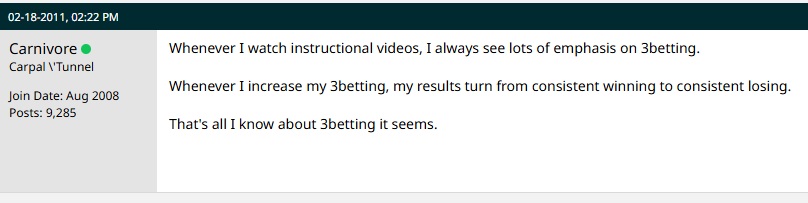
As you can see by the previous RFI charts, we want to raise big pairs from any position. We are also happy to raise limpers with them. And we are generally happy to three bet with them, although as previously mentioned, all situations are relative. Incidentally, a lot of poker instructional videos place too much emphasis on three betting. 2+2 poster carnivore said it well.
Three Betting
Three betting means re-raising before the flop. If you are confused about the name, consider that the first bet is the big blind. The second bet is then the initial preflop raise, and the third bet is a re-raise. You can also three bet on the flop, after say a bet of $10 and a raise to $30, any re-raise at this point would be a three bet.
So we can begin with the uncontroversial opinion that we want to three bet AA. Actually, Caro makes a compelling case that AA plays better as a flat a lot of the time. And here I have a hand example from an actual hand I played about a year ago at Masters Poker in Malate, Manila, Philippines.
The game was ₱50/₱100 and it was a decent game. Mostly recs, although there was a Russian pro on my right that I had some history with. And I had played with some of the recs before as well. A rec - a younger Filipino guy, with some tattoos - opened from early position. The Russian pro three bet, and I look down at AA in the SB and put in the four bet. The rec folds - after the hand said he had AK and I believe him - and the pro folds KK face up. His fold is reasonable. He is a tight reg, and I am a tight reg. His range there is quite snug, and I would probably just fold AK and QQ to his three bet. Even the rec is opening fairly conservatively from EP. Now if I flat, the rec probably jams his AK. Now I'm not saying that four betting was wrong. It is right according to some basic poker principles. We don't want to give free cards with strong but vulnerable hands. We don't want to slowplay when other players can have big hands. But the thing about general rules is that they are not infalible. They are not always applicable in every case.
Anyway, the case for three betting AA is very obvious but it behooves us to go through it, if only to lay a solid foundation on which we can later build a more sophisticated three betting strategy. AA is a massive favourite against any hand. Against a smaller pocket pair AA is 80/20. Against a suited connector, it is 77.5/22.5. Against KhJs it is 86.5/12.5. If we look at a flop distribution chart vs KJ, the case is even more compelling. 95% of the time, AA flops > 50% equity against KJ. 90% of the time, AA is still ATLEAST a 3:1 favourite. So by three betting, if we get called, we create a pot that we will be a massive favourite to win.
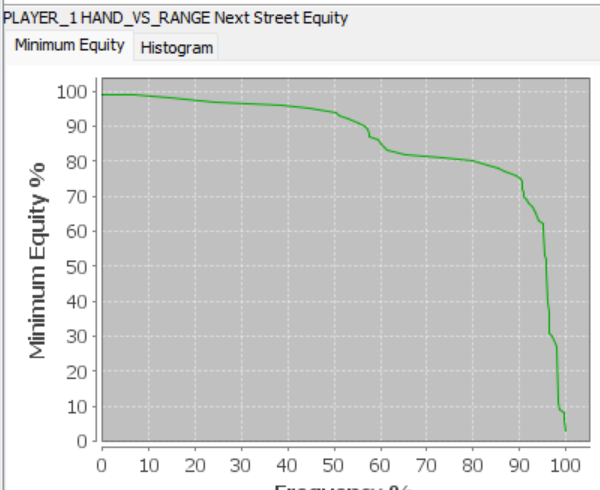
Okay. Three betting AA is pretty obvious. From there, we can infer three betting with KK would be fun and profitable as well. After all, KK is a lot like AA. The only big differences is that now there is a class of hands opposing KK, which is Ax. An overcard. Which is no big deal still because KK vs AT (for example) is still a 70/30 favourite. The second big difference, is that KK loses to AA. This might not seem like a big deal, because after all pocket pairs are rare. You only get AA 1 in 220 times. You only get KK 1 in 220 times. So running KK into AA should be extremely rare. And it is. However, once you three bet a tight raiser, and another tight player re-raises you, the probability goes way up.
Three betting in NLHE is ultimately a factor of our opponent's raising range, and our position. Poker is a game played against the whole table. So things are very different when we are in early position, say UTG+1 vs an UTG open, then if we are on the button vs that same UTG+1 open. Likewise, even if UTG is a maniac opening 50% of hands, we still have to be aware of the other 8 players at the table when we are UTG + 1. If UTG, a maniac, raises to 3bb, and we three bet to 10 bb, we are betting not only against UTG, but against the whole table. And they are probably going to react very conservatively to our three bet, only continuing with very strong hands. Meaning that we are now in a game theory sense losing to all of them.
The problem with three betting at low live stakes games, is that often our opponents employ very passive strategies. If they are only raising with strong holdings, then you do not get a lot of opportunities to three bet. When you three bet someone, they will fold part of their range and continue with the rest. So we need to be not just stronger than their opening range, but a decent favourite against their continuing range in order to have a profitable three bet. Otherwise we are just turning a strong hand into a bluff, which might work on ocassion but is in general poor strategy.
However, when we do encounter a maniac, we shouldn't be afraid to punish them accordingly. Let me tell you a story about a 50/100 hand that happened at Okada not too long ago.
An Encounter With A Maniac Whale
There I was, playing 50/100 NLHE at Okada. The game seemed tight at first. It was mostly just people folding to each other. I was just about to hop on the 25/50 list, when I picked up KK in EP and decided to limp. Limp raising KK or AA from early position in a full ring game can be a powerful tool. A lot of people who play live poker are impatient and want to play big pots. And because loose limping is so common, it is easy for someone who isn't familiar with your game to not give your limp the proper respect it deserves. In this case, an old man minraised my limp to 200. This is already quite strange, and signifies him to be a whale. I mean who minraise isos? It's such a bizarre play I'm tempted to encorporate it into my arsenal. Anyway, a few people called, and I came over the top with a big back raise to 1600. The old man called, everyone else folded. I was a little short at the time, playing maybe 8k or something. With so much in the middle I was ready to ram and jam on almost any flop. But when the flop came:(4000) Ad8s7c
my blood ran cold. Worse yet, I was out of position. I decided to put out a 1400 CBet. With any luck, I would take down the pot. Unfortunately my opponent called.
The turn and river bricked out, and we checked it down. I think the old man was just as scared as I was. He ended up showing down A2o and taking the pot.
Actually, the old man is not the focus of the story. But he was the reason I reloaded to 20k. Unfortunately we didn't really get any chance to tango the next two hours that he was at the table, although he continued to open raise light from every position.
No, my encounter was with the next player who sat down at the table. Right away, the whole table could tell that this guy was different. Almost every hand he would raise before the flop. And after the flop he was highly aggressive too. Bluffing, value betting. And he sat down with 30,000 PHP in chips. This was a man who came to play. After about an hour of watching him, sizing up his game, I picked up KQo. Normally, this is a hand I would fold against a raise. Usually when people raise they have a hand like AK or AA which dominates KQ badly. But this guy had raised every hand for an hour. Against a 100% range, we are a 62% favourite. So I made it 1800. The old man called the 1800 cold, and the maniac called as well.
The flop (5550) came down Q74 with two spades.
Maniac checked, and here I made a large bet. 4300. When I have a pretty strong hand against two very loose opponents, I don't mess around. I make large bets and extract that thick value. The old guy folded, and the maniac called.
The turn came a 6, completing an odd ball 58 draw. No spade thankfully. With 14k out there, and about 17k in my stack, I jammed. These sort of spots, when you are all in for a big amount, when you have a hand that you can go with
but you aren't even sure if you are good, are gut wrentching. The first thing was I faded the snap call. That was very good. It means he probably wasn't slowplaying me on the flop. Then I started wondering if he could hero fold AQ.
How sick would that be. At this point I started cursing myself for playing such a big pot with KQo. Finally he called. The river paired the 6, and my hand was good. He showed a queen, so he clearly had some trash queen. Anyway, the lesson is, three betting maniacs with okay hands can be
profitable.
Poker Math & Expected Value (+EV)
At its core, poker is a game of mathematics disguised as a game of psychology. While reading your opponents is important, the foundation of every winning strategy is making mathematically sound decisions. Every action you take at the table should have a positive Expected Value (+EV).
Expected Value (EV)
Expected Value is the amount of money you can expect to win or lose on a given play in the long run. If a play makes you money on average, it is +EV. If it loses money on average, it is -EV. To be a winning poker player, you simply need to make +EV decisions and avoid -EV ones. Short-term variance (luck) might cause a +EV play to lose on a given night, but over thousands of hands, the math will always prevail.
Counting Outs and The Rule of 2 and 4
When you are drawing to a hand (like a flush or a straight), the unseen cards that will complete your draw are called "outs." For example, if you hold two hearts and there are two hearts on the flop, there are 9 remaining hearts in the deck. You have 9 outs to make your flush. If you hold an open-ended straight draw (like 8-9 on a 7-T-2 board), any 6 or Jack will complete your straight. There are four 6s and four Jacks, giving you 8 outs.
To quickly calculate your percentage chance of hitting your outs during a hand, use the Rule of 2 and 4:
- On the Flop: Multiply your outs by 4 to get the approximate percentage chance of hitting your card by the river. (e.g., 9 outs for a flush x 4 = 36% chance).
- On the Turn: Multiply your outs by 2 to get the approximate percentage chance of hitting your card on the river. (e.g., 9 outs x 2 = 18% chance).
Pot Odds
Once you know the probability of hitting your hand, you need to compare it to the "Pot Odds" to determine if calling a bet is +EV. Pot Odds are the ratio of the current size of the pot to the cost of your contemplated call.
For example, imagine the pot is $80, and your opponent bets $20. The total pot is now $100, and it costs you $20 to call. Your pot odds are 100 to 20, which simplifies to 5 to 1. Expressed as a percentage, you are paying 1/6th of the total final pot, meaning you need to win the hand at least 16.6% of the time to break even.
If you are on the turn with a flush draw (9 outs), the Rule of 2 tells you that you have an 18% chance of hitting your flush on the river. Since your 18% chance of winning is greater than the 16.6% pot odds you are being offered, calling the $20 bet is a +EV decision. If your opponent had bet $100 into the $80 pot, your pot odds would be 180 to 100 (1.8 to 1, or roughly 35%), making a call severely -EV.
Implied Odds
Sometimes, the direct pot odds are not quite good enough to call, but you can still justify it using "Implied Odds." Implied Odds take into account the future bets you expect to win on later streets if you hit your draw. If you are drawing to a well-disguised straight and you know your opponent has a strong hand they won't fold, you might call a mathematically -EV bet on the flop because you stand to win their entire stack on the turn or river when your straight comes in. However, relying too heavily on implied odds without strong reads is a common leak for amateur players.
Post Flop Play
Value Betting
The most virtuous of all poker plays is the value bet. This should form the core of your poker strategy. Value betting is simply betting with a strong hand. The best part about a value bet is you can't lose. Either your opponent calls, in which case you build a big pot as a favourite, or they fold, in which case you win the pot. There is however significant nuance when it comes to value betting. One can go for thick value, say with top set or top two pair, or thin value, for example with middle pair. Thin value betting is a great skill to develop, and can really ramp up your winrate and make you a feared poker player.
Your opponents player profile is also relevant when determining whether or not to value bet. Against a loose player, who calls anything, you can value bet more aggressively than against a conservative player who does not like to call bets. Against a tough opponent, who is capable of bluff raising, you should also consider that value betting might cost you the entire pot, if you plan to fold to their raise. However against most of your typical low limit opponents you can value bet freely without much concern. And you should.
Don't make the mistake of auto checking the river either. A lot of players auto check the river in live low stakes nlhe games. This is because bets on the flop and turn can not only earn you value, they can also win you the pot or prevent you from losing the pot. A value bet on the river is not going to win you the pot, but it can still often be profitable. At the very least, you should engage in a cost benefit analysis. In order for a value bet to be profitable, it needs to win more than 50% of the time when called. Try to break down what calling combos villain can have, and how many of them you beat.
Advanced Post-Flop Concepts (C-Betting & Board Textures)
While value betting is the meat and potatoes of poker, you simply will not make a strong hand often enough to rely solely on it. To truly become a winning player, you must master the art of winning pots when you miss the flop, which requires a deep understanding of Continuation Betting (C-Betting) and board textures.
Continuation Betting (C-Betting)
A Continuation Bet is a bet made on the flop by the player who was the last aggressor before the flop. The logic behind the C-Bet is simple: in Texas Hold'em, most hands miss most flops. If you raised preflop, you represented a strong hand. By betting the flop, you are "continuing" that story, claiming that the flop helped your strong range. Often, your opponent will have missed the flop entirely and will be forced to fold, allowing you to win the pot uncontested.
However, you cannot blindly C-Bet 100% of the time. Doing so makes you highly exploitable to check-raises and floating (calling with the intention of taking the pot away on a later street). Your decision to C-bet should be heavily influenced by the board texture.
Board Textures: Wet vs. Dry Boards
Dry Boards: A dry board is uncoordinated and lacks draw potential. Examples include K♠ 8♦ 3♣ or A♥ 2♠ 2♦. These boards are excellent for C-Betting, especially when you have a range advantage (e.g., you are the preflop raiser and the board contains a high card like an Ace or King that hits your opening range perfectly). Because there are no flush or straight draws available, your opponent will likely fold any hand that didn't pair the board.
Wet Boards: A wet or dynamic board is highly coordinated, such as J♥ 9♥ 8♣ or 7♠ 6♠ 5♦. These boards connect heavily with the hands players typically call preflop raises with (like suited connectors and middle pairs). Wet boards are dangerous. When the board is wet, you should C-Bet less frequently. If you do bet, you generally need to bet larger to charge opponents who are drawing to straights or flushes. Checking back your marginal hands or even strong top pairs on wet boards can be a wise move to control the size of the pot.
Check-Raising
If you are out of position and you call a preflop raise, you shouldn't just play 'fit or fold' on the flop. A powerful weapon against players who C-Bet too often is the check-raise. You can check-raise for value when you flop a monster (like a set), but balancing that with check-raise bluffs (using hands with good equity, like flush draws or gutshot straight draws) makes you incredibly difficult to play against. It forces the preflop raiser to fold their weak C-Bets and punishes them for playing too aggressively when in position.
Zero Street
We'll get back to postflop play in just a moment, but now I want to talk about another topic. One that is more appropriate to address after some introduction to poker strategy
The concept of 'first street, second street etc.' is mostly a holdover from seven card stud. However, I would like to introduce the concept of the Zero street.
Zero street occurs while you are sitting at the poker table, before you play your hand, and between hands. It is my contention that Zero street is the most important street in poker.
Tommy Angelo refers to this as 'sixth street' in his work 'Elements of Poker'.
Sixth street starts when the betting stops. Sixth street is when players relax, which is why it pays not to. Sixth street is when statues become fountains. While playing the turn and river, the players are stoic, doing their best to give up as little information as possible. And then, as soon as the betting stops, their parts start moving, broadcasting information about their thoughts, their feelings, and their cards. Sixth street is when players let their guard down, as if all of a sudden it’s safe to reveal classified secrets to the enemy. It’s like they don’t even know the war is still going on.
I was at River Rock Poker Room in Vancouver, many moons ago, waiting to get in the 2/5 game. There were two tables, and I was observing the action. The message girl, whom I was friendly with, asked me if it was really possible to get much idea about a game just by watching it. And yes, you absolutely can. In fact, from that priviledged position outside the game, I was able to observe my opponents while at the same time giving away nothing about my strategy. Talk about your assyemtrical information advantage! Equally important however, was determining which of the two games I wanted to play at. And that too was quickly apparent, as one game featured a lot of folding with pots being vigorously contested heads up, while in the other game almost every pot was mass multiway, with players trying to limp in with any two cards from any position. Gee, I wonder which of these two games would be more profitable?
The first decision you have to make at a poker table is your stack size. Most games are going to have a minimum and a maximum. Sometimes the game will be uncapped, meaning there is no max. But that's not very common these days. There are a number of different buyin strategies you can employ. Many poker theorists, especially in the context of games with a 100 big blind max buyin, simply recommend that you buy in for the max, and top up if you lose any chips. This is a reasonable approach, especially for low stakes play. But what about a game with no cap? Or a game with a 500 big blind cap? While this simplistic strategy is attractive and effective, it is not optimal.
A theory of optimal stack size: the optimal stack size is a factor of the skill levels of your opponents and their stack sizes. Basically, you want to have your stack size around where the fish are. If the fish are deep, then you want to be deep. If the fish are shallow, then you want to be shallow.
So when you first sit down at a table, usually you won't know who the fish are and who the regs are. So the ideal buyin amount is actually the minimum. Then you can play for a while, get a read on the table, figure out how everyone is playing, and top up if table conditions warrant it. You might find out that actually the game is quite tough, and it isn't worth adding on extra money. In that case you won by buying in for the minimum of say $200 at a $2/$5 table instead of $500, because you limited your variance and your losses in a game that wasn't worth playing. Furthermore, being short makes necessary a certain conservative style of play which has less downside (and less upside) potential. Essentially, the point I am trying to make, is if you are going to take a risk, the potential reward should be worth it.
Being short can also be an advantage, even if everyone is playing good. If everyone else is deep, and you are short, then your opponents need to focus on each other. That is where the potential to win or lose a big pot. This lets you slip through the radar, and employ a strategy which your opponents don't or can't counter.
Another powerful technique when you are on Zeroth street (for example if you fold preflop) is to keep track of all the action in your head. Preflop who limped, who raised who called. Same for the flop, turn, and river. Any experienced poker player can do this, although it is a bit drianing and takes focus. Then, once a hand goes to showdown, you can recreate the action and look at the decisions that one of the participants made. This is a great way to get a read on your opponents and to form some hypotheses about their play, which you can later confirm or refute.
Bankroll Management
Bankroll mangement is a crucial skill that winning poker players need to develop. One basic metric that is thrown around - and it is really too general to be useful, but we have to start somewhere - is to have 20 buyins for your game. So if you are playing $50 NLHE, you need $1,000. That gives you enough bankroll to handle most of the variance that poker can throw at you. You get outdrawn in a couple big pots. You get coolered. You lose 4 or 5 buyins. That happens. Then things turn around and you start crushinhg again. Hopefully.
Of course there is nothing magical about 20 buyins. And the type of poker you are playing matters also. There is a statistical concept known as standard deviation, which measures how much variation you can expect to see from the expected result. In poker, at least for online poker, this can be expressed in terms of big blinds per 100 hands. The higher the std dev, all other things being equal, the greater your bankroll requirements.
The importance of bankroll management cannot be overstated. By practicing sound, conservative bankroll management, you can essentially reduce your ROR to 0%. Consider that you start with 50 buyins for $.50/$1.00 or $5,000. Assuming you are a winning player earning 4 bb / 100, your chances of hitting a 50 buyin downswing is pretty remote. And even if that happens, it has to happen before you earn enough to cover it. So essentially it has to happen at or towards the start of your journey in order to be destructive to your bankroll. But by implementing a plan to move down at say $2000 to .25/.50 and then again at say $1000 to .10/.25 even after a 50 buyin downswing you would still have a bankroll and still be able to grind. And every day that you are grinding, and studying, you are steadily improving your skill level. And the skills that you develop at low stakes will translate very well into skills at higher stakes games in the future. But in order to keep growing and improving as a poker player, you need to have a bankroll. You need to practice sound bankroll management, even if it means grinding for micro stakes online.
One of the great things about the internet age is that poker is more accessible than it has ever been before. In a casino, the lowest game you will find is $1/$2 or sometimes even higher. That requires a bankroll of at least $5000. But online you can play $0.01/$0.02 with a 100 bb buyin of $2 and a bankroll of $40. In fact even smaller stakes games exist denominated in INR and PHP.
We can taxonomize between three types of players, each will have radically different bankroll requirements.
- Recreationals
- Semi-Professionals
- Professionals
Recreational Players
Recreational players do not really have bankroll requirements. Instead, they have a budget, based on their "fun money" left over after bills and other obligations are met. If they win, so much the better. If they lose, no big deal, it was money that they could afford to lose anyway. One of the great things about poker is there are no minimum triproll requirements. The term triproll means how much money you need to have on you to play poker, as opposed to bankroll, which is the amount of funds you have dedicated to the game of poker in total (including cash on hand, money in the bank, safety deposit box, poker site etc.). While it is true that most semiprofessionals and professionals will want to have to ample buyins on them, especially if they are going away for a weekend trip, in order to make sure they can keep playing even if negative variance strikes, technically any amount of money is enough to play poker. You don't even necessarily need 100 big blinds, because short stacking can be a viable strategy (especially in the context of high limit games).
Semi Professionals
Semi-professionals however do have more rigid bankroll requirements. A semi-professional is someone who plays poker but also has another source of income. A day job, if you will. Poker actually makes a great part time job. Playing fewer hours helps keep your volume clean and your game fresh. If you run bad or you need to grow your bankroll, then you can just ramp up the hours at work. Conversely, if you are crushing it in some soft games, you can scale down your part time job or time you devote to your small business. For a semiprofessional, we have to return to the dread 20 buyin figure. This is a reasonable starting place. With 20 buyins, you can absorb most of the variance that comes with grinding seriously. But it all depends. One idea is that as you increase in stakes, your bankroll requirements in terms of buyins should increase as well. This reflects the fact that $50,000 at $5/10 is a different thing entirely than $10,000 at $1/$2. Meaning is a lot easier to replace $5,000 or $10,000 than it is to replace $50,000. So you might start with say 20 buyins at $1/$2 ($4000) but require 30 buyins to try $2/$5 ($15,000). Exact bankroll requirements for whatever game you are playing need to be individually assessed. A semi pro can afford to be relatively aggressive in moving up limits and taking shots, because they can always fall back upon their day job if things go south.
Professionals
Professionals - meaning someone who earns most of their income from poker - have the most stringent bankroll requirements.A good starting point is something like 50-100 buyins, as well as 6 months living expenses. This is sufficient funds that a winning player shouldn't have to worry about day to day variance, and can instead fcous on the minutaie of being a winning poker player.
Other Bankroll Management Tips
Top Ups
How you manage your bankroll goes beyond simply how many buyins you have. Consider for example a bankroll tactic that I have pioneered. The micro top up. You sit down at a $1/$2 game with $100. You fold for two orbits. The action is incredible, once you fold your small blind, you top up for $35 more. The micro top up. Maybe other people do this and I just never notice, but I don't really recall anyone ever doing this. Most people rebuy if they lose a big pot, or if they go broke. And that makes sense, you need to top up to keep playing when you get stacked. But if I fold for two orbits, chances are I am playing well. So it seems like the perfect time to invest some more money, especially if the game is good. And the better the game, the more money we should be prepared to invest. That means we should be ready to rebuy if we get stacked, and we should be more aggressive about topping up. Another tactic in the context of low stakes games with a maximum buyin, is to constantly top up to 100 bb if you fall below. You do this by having chips in a bag. Every time you lose any amount of money, you top up for that amount.
The 10% Rule
Another important bankroll strategy is to never have more than 10% of your bankroll on the table. For example, let's say you are playing $1/$2 NLHE and you buyin for $200. You lose your stack and rebuy for $200. You get stacked again and rebuy. Then you go on a tear, and now have $1,000 in front of you. If your total poker bankroll is less than $10,000 AND there are players who cover you, then it is wise to quit the game, because that is too much of your bankroll to expose to the fluctuations associated with playing poker. And you won't be able to play your best with so much money at stake.
Mixing Limits
Within the context of online play, mixing limits can be highly effective. For example, if there are ten tables available at .10/.25 and ten tables available at .05/.10, then by playing both limits you can game select from twenty tables instead of ten. Playing the best games at both limits will maximize your BB/100 winrate. Furthermore, if you are a multitabling, as most serious online poker players are, you can transition from one limit to the next without serious risk by slowing adding tables into the mix. Let's say you have $1,000 in your bankroll, and you are playing $0.05/$0.10. With 40 buyins now for $25 you want to take a shot. If you normally play 6 tables of NLHE $10, then your next session you can play 5 tables of NLHE $10 and 1 table of NLHE $25. Or you could take an even smaller step, and play that 1 table of NLHE $25 for only half your session. This allows you to gain some experience at NLHE $25, without risking any serious piece of your bankroll. Whereas, if you play all 6 tables, one disaster session could easily cost you 10 buyins - not because you are playing badly, just because you encounter a rough patch of negative variance. But that would be 25% of your bankroll gone, which is an unacceptable loss. That same downswing at NLHE $10 is only 5 buyins. Now as your bankroll continues to grow, you can add in more and more $25 games. For example at $1,100 play two tables, at $1,200 play three. Or whatever you are comfortable with. But come up with a plan so that you are slowly adding on more tables. And conversely, if your bankroll shrinks, then you start removing NLHE $25 tables and re-add NLHE $10 tables.
You can also do this with live poker. For example, if you are grinding $1/$2, and you want to start taking shots at $2/$5, you can add in just one or two hours of volume at $2/$5 out of a six or seven hour session.
A Poker Business Plan
This brings me to my next point. It is imperative that you develop a poker business plan. Here is an example plan. I have $1,000 in my poker bankroll. I will play NLHE $10. At $1,500 I will begin mixing in some NLHE $25. At $500, I will start mixing in some NLHE $05. That is the essenece of a poker business plan. Where you are now, when you will move up, when you will move down. You could go into greater detail about how you will mix limits. You could also include plans to increase your bankroll by adding outside funds. This can be an effective way of moving up the limits when you are in the micros, while at the same time getting valuable experience and improving your poker skill set.
Tells
The first thing you need to know about tells is that strong means weak, and weak means strong. I mean, think about it. If you had a big hand, would you want other people to know you had a big hand? Or vice versa, if you had trash? However, it is important to distinguish between actors and non-actors.
Poker Journal
Keeping a poker journal is an extremely powerful tool for any aspiring poker professional. Journaling encourages reflection, which is fundamental to growth. And the best way to improve as a poker player is the 'inch worm' method of improvement popularized by Jared Tendler in his important work 'The Mental Game of Poker'. Tendler argues that the best way to improve is first begin by shoring up your weaknesses, rather than trying to develop new tricks or techniques. The way that an inch worm moves is, before moving its front forward, the worm brings its back up, arching in the middle. Then once the weaknesses have been addressed, you can attempt to expand your game.
The Mental Game of Poker
Tilt
According to Jared Tendler in 'The Mental Game of Poker', Tilt occurs when feelings of anger and frustration build up over time. Normally what happens is when you get angry or frustrated, the emotion sort of lingers in your mind afterwards, but eventually - especially after you sleep - it goes away. You process the emotion and it dissipates. But when you keep experiencing anger and frustration on a regular basis, there is a build up of this emotion in your brain, because not all of it dissipates. And each adverse event that occurs triggers an intense emotional reaction because you have all this residual emotional energy. And then finally you reach a critical point where your emotional brain overwhelms your rational brain.
One thing I have noticed is that tilt transcends games. If I am tilted in poker, then I also play StarCraft differently. Mostly, I play a lot more aggressively. I choose aggressive strategies that I know have a relatively low probability of success, such as an early pool attack. Likewise, people on tilt in poker will often make big plays with weak hands - bluffs.
Flow
Flow, also known as 'being in the zone', is what Mihaly Csikszentmihalyi describes as a process of total immersion in an activity. Entering the flow state is highly pleasurable, and also enables one to maximize their creative potential. When in flow, playing your A game is as effortless as breathing. However, it is not easy to simply enter this state. But you can train yourself to enter a flow state. Csikszentmihalyi was basically a flow pioneer and his work on the topic, titled "Flow" is a definite must read.
Bet Sizing
In No-Limit Hold'em, the size of your bet is the primary mechanism through which you communicate with your opponents, dictate the pace of the hand, and manipulate the mathematical realities of the pot. Because you can bet anywhere from the minimum required amount up to your entire stack, mastering bet sizing is one of the most complex and rewarding skills in the game.
Preflop Sizing: Opens, Isolations, and 3-Bets
Before the flop, your primary goal is to thin the field and build a pot when you have an advantage. A standard open raise size (RFI) typically ranges from 2.5x to 3x the big blind online, and up to 4x or 5x in loose live games. The key is consistency: you should generally use the same open-raise size from a given position regardless of whether you are holding pocket Aces or suited connectors. Varying your sizing based on hand strength turns your bets face-up to observant opponents.
When dealing with limpers, the rule of thumb is to take your standard open size and add 1 big blind for every limper. So, if your standard open is 3x and there are two limpers, your isolation raise should be 5x. If you are out of position (e.g., in the blinds), you generally want to add another big blind to discourage callers and negate your positional disadvantage.
For 3-betting, a standard heuristic is to 3-bet to roughly 3x the original raiser's bet if you are in position, and 4x if you are out of position. For example, if a player opens to $10, you should make it $30 on the Button, but $40 from the Small Blind. The larger size out of position gives the raiser worse pot odds to call, compensating for your lack of position post-flop.
Post-Flop Sizing: Texture, Range Advantage, and Polarization
Once the flop hits the felt, your bet sizing should be dictated by two main factors: board texture and range advantage.
Small Bets (25% - 33% Pot): Small bet sizes are highly effective on dry, static boards (like K♠ 8♦ 3♣). On these textures, hand values are unlikely to change drastically on future streets, meaning you don't need to bet large to deny equity to draws. A small bet forces your opponent to continue with a wide range of hands, allowing you to extract thin value or fold out their complete air cheaply. Small bets are also preferred when you have a significant "range advantage"—meaning the board favors the types of hands you would raise with preflop much more than the hands your opponent would call with.
Medium-to-Large Bets (66% - 75% Pot): Larger bet sizes should be utilized on wet, dynamic boards (like J♥ 9♥ 7♣). These boards feature heavy draw potential (flush draws, straight draws), meaning your opponent will have many hands with high equity against your made hands. By betting large, you are charging them a premium to realize their equity, effectively giving them bad pot odds to chase their draws.
Overbets (120%+ Pot): Overbetting is a relatively modern, high-level tactic used when you have a "nut advantage." This means your range contains the absolute strongest possible hands on a given board, while your opponent's range is capped (because they would have raised preflop or on earlier streets with their strongest hands). Overbets put immense pressure on medium-strength bluff-catchers, forcing opponents to play a guessing game for their entire stack. When you balance an overbetting range with the stone-cold nuts and perfectly selected bluffs (usually holding key blockers), you become a nightmare to play against.
Pot Geometry and Planning Ahead
Finally, expert bet sizing involves "pot geometry"—the practice of reverse-engineering your flop and turn bet sizes to achieve a specific Stack-to-Pot Ratio (SPR) by the river. If you hold the nuts and want to get all the money in by the river, you must calculate exactly what percentage of the pot to bet on the flop and turn to make your river shove look mathematically natural. Failing to plan ahead often leads to awkward situations where you want to shove the river, but the remaining stack size is either far too small or massively over the size of the pot, letting your opponent off the hook.
The Benefits of Table Starting
Starting tables can be highly beneficial, both in the context of live and online poker. Now not every online pool is the same. With high liquidity, tables can fill instantly, depreiving you of the opportunity to capitalize on short handed play. But in smaller pools, or at off peak times, you can often play extremely short handed or even heads up while starting tables. This can be highly beneficial.
Consider for the moment you are playing at a 6 max table with four regs and a 50/5 fish. This is a losing player, who plays too loose, but knows enough to fold the weakest of hands. Now their loss rate first has to overcome the rake and not just the rake of the fish, but the rake of all players - and then can be divided amongst the remaining winning players. Since a 6 max table is generating anywhere from 50 to 100 bb/100 in rake, that is tough for even a single fish to do. And even if they do manage to lose that much, you still have to split what is left over with 4 other players. Conversely, if you are playing heads up, the losing player has to only pay the rake for both of you, and then you get 100% of their loss rate to yourself. And if you are paying 3 handed with two fish, it is even better. Furthermore, heads up or three handed games go much faster than 6 max games. Any time you fold heads up, the hand ends immediately. No waiting. So you can easily get 200 or 250 rounds per hour, whereas even 100 rounds per hour is hard to achieve in 6 max play. And because you are playing so many hands against the same player or same two players, you can often develop very intimate reads on how they play, thus enabling you to win at an even higher rate.
Now getting losing players to play you heads up is no small feat. But table starting is the perfect way to get this to happen, because fish are usually impatient, and don't want to wait for a game to start. So if you are just sitting at a table on your own, there is a good chance a fish will drop in to play. And regs usually recognize that someone who is table starting is going to be a reg and not a fish, so there is no reason for them to sit you. Of course if a reg does sit you, you can just quit. Now as the game fills up, so long as it remains populated primarily by fish, you can just keep playing. And as the fish bust and regs join, then you can quit the game and start the process over again. This table starting process can be extremely lucrative for those willing to put in the effort.